A Fan's Travels in the Land of Umpires

Tuesday, November 29, 2011

Final Reflection

After reading this memoir, I was greatly impressed with the quality of writing and the voice that the author chose for it. The voice for this book was very relaxed and open, while maintaining professionalism. I could hear the author talking to me about umpiring and all the research he did, as well as the many interviews he conducted with current and former umpires.
My favorite thing about this book was the way it spoke about the Land of Umpires. Bruce Weber spoke about this Land with a mystical air. It was almost as if he had to speak about the Land in a specific way, in order to properly do it justice. When the author had been thinking about writing this memoir, he had done several interviews with umpires from both the major leagues and minor leagues. “I came away from these three stories convinced that a land of umpires exists, that it has citizens, laws, and a culture, and that it is exotic enough-both in the context of baseball and the context of, well, the known world- to warrant further exploring” (4). This land of umpires offered a great deal of promise for the author, who decided to become an amateur umpire himself in order to further research it.
The main reason I chose this book was because I felt that it offered a different perspective into the baseball world. After reading it, I see that not only did the author provide a different perspective; he introduces the reader into an entirely new world that is within the vast world of baseball. I also felt that the author considered umpires to be a class all their own, somewhere in between players and fans; however after reading, the author has created an entire new world exclusively for umpires.
I am very pleased that I was able to gain this new insight into baseball, and that I was given the chance to view my favorite sport from an entirely new perspective.

Monday, November 28, 2011

Connections


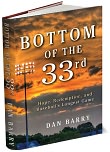
Another work that compares to As they see ‘em is a book called Bottom of the 33rd. Bottom of the 33rd is a book by Dan Barry, and it details the longest game in baseball history, which lasted 33 innings, while a regular baseball game lasts only 9. Both books, obviously, are about baseball, and both explore hidden baseball worlds that not many people get to experience. As they see ‘em explores the little-known world of umpires, while Bottom of the 33rd explores the world of the longest game.
The styles of both authors are very similar in how they tell their stories. Both authors speak of the hidden worlds with a very mystical quality, as if they are preserving the customs of their respective worlds in their writing. While Dan Barry did not personally enter the world of the longest game, he captures its magic very well in his writing. Bruce Weber actually entered the Land of Umpires, and so was able to write about them easily, having had experiences from their world.
Figurative connections between these two works can also be found. Both books explore the hidden meanings behind aspects of the worlds they study. For example, when Dan Barry rhetorically asks those involved in the longest game, “Why did you stay?” (14), the players seem to answer, “Because we are bound by duty. Because we aspire to greater things. Because we are loyal. Because, in our own secular way, we are celebrating communion, and resurrection, and possibility” (14). In As they see ‘em, Bruce Weber describes what it is like learning to be an umpire: “You master the fundamentals, you cast them off when they don’t serve, and in the end you accommodate yourself to the game and its participants. It turns out you’re not alone out there. It only feels that way” (3). By giving the reader a look into their respective worlds, Dan Barry and Bruce Weber are able to give the reader a general idea of what being in that world would be like.
In the hidden aspects of each world, both authors show the reader the desires of the characters. In As they see ‘em, the second sentence of the book illustrates a desire for respect: “Umpires place great stock in their appearance, and if you’re caught trying to make a call or follow a play with your hat askew or caught in your mask straps or- the worst- spilled in the dirt, you look foolish, inept, exactly the image you don’t want the ballplayers, the managers and coaches, or the fans to have of you” (1). If the umpire does not demand respect from others on the field, he will not gain any from them. Likewise, in Bottom of the 33rd, the players, whether they are on the home or away teams, all desire to leave the minor leagues and be called up to the majors: “These ballplayers… played briefly for Boston last season, and are hoping to return to that magical place where someone else carries your luggage” (35). For both books, the main theme of each is desire.

Title Significance

The title of my memoir is As they see ‘em. In a literal sense, this means that during a game, the umpires call plays based on how they see the play. If the plate umpire, for example, sees that the ball was a strike, he will call it a strike. The players and the managers might have seen the pitch differently, and they may come out and argue with the umpire. However, no matter how much the players and managers argue, the umpire will still stand by his decision. The umpire is required to stick by his decision, even if he realizes that he called the wrong thing, because if he changes the call based on what players and managers say they saw, he is undermining his position as the authority on the field. If the umpire undermines his position as the authority, he loses respect from players and managers.
This also ties in to the figurative meaning of the title, which is that umpires are the main authority on the field, and thus are required to be treated with respect. Sadly, as the author points out several times throughout the memoir, most umpires do not receive such respect on the field. If players and managers do not agree with a call that the umpire has made, they will fight with the umpire rather than accept his decisions. Umpires do not receive much respect off the field either. For example, on page 230, the author was interviewing an umpire who had called a perfect game in 1999. (A perfect game is when there are no walks, hits, or errors for one team). The umpire said that people had been calling all around about the game, but nobody had congratulated him for calling the game. “For a few days afterwards, I was thinking, ‘A perfect game. And nobody cares’” (230). Without this umpire, the perfect game might not have occurred. A different umpire might have called things differently and the game could have ended up being 10-0 for the other team.  This quote shows that many fans take the umpire for granted, and that most people don’t appreciate the work that the umpires put in and how essential they are to the game. The title As they see ‘em shows that the umpire is definitely worthy of respect and that he deserves respect for the hard work he does on the baseball field. 

Sunday, November 27, 2011

Emotional Reaction

A specific paragraph in this book really stuck with me after I read it. This paragraph was a quote from umpire Mike Everitt, who spoke about the effects of working in the postseason.
“In these games you definitely have a different mentality… The regular season is a physical grind, but the postseason is a total mental grind. It’s such a confined, concentrated experience. You know it’s going to end, but the pressure is just so intense” (289-290).
This paragraph stuck with me mainly because it reminded me of the experience of final exams in school. With final exams, they seem to be like the postseason of the school year. During the regular school year, you’re learning many new things. All year, however, you are preparing for the final exams at the end of June. After the exams, the year is over, and you have summer vacation before you come back in September.
In baseball, you have the regular season, which are all the normal games. These are to prepare the teams for the postseason in October. October begins the postseason, which is much more competitive than the regular season. Once you have the postseason and the World Series, the teams have a break for the winter, and come April, they start all over again.
For umpires, the regular season, as stated, has its physical toll, but it’s not until the postseason that the real pressure begins. Teams also feel pressure in the postseason, but it seems to be worse for the umpires, who are in charge of keeping order. The umpires directly influence the outcomes of games, but they cannot be favorable to either team. This is similar to teachers, who influence students while teaching them, but cannot give them all the answers to everything.
I also enjoyed the wording of this paragraph because I felt like I could relate to it, as a student. While I understand that umpire pressure is worse, I feel like I can relate because I face many pressures as a student in high school, whether they be academic, social, or others.

Saturday, November 26, 2011

Passage Analysis

The passage I selected for my analysis was found on page 266 of my memoir:
“It’s hard to explain what it feels like taking your position for the first time as an umpire on a big league diamond, but psychologically speaking, I think it akin to what it must be like commanding an army on the battlefield for the first time, or ascending to the throne after the king dies; you survey the field, and it seems to stretch on forever, and it occurs to you that this is your territory, your domain, that you’re supposed to assert dominion over it and that you don’t have a clue of the appropriate method or demeanor for doing so” (266).
This passage puts the umpire in a place of power over the baseball field, showing that he is in charge of maintaining order and stability. The umpire is in charge of calling strikes, balls, fouls, fairs, safes and outs, and many other things. He has the power to eject players and managers who do not behave, and he ultimately decides the outcome of a baseball game, without being favorable to either team playing. In this passage, the big league field is emphasized in that it symbolizes accomplished desires. Here, the author is a newly graduated umpire, and yet is getting the chance to work a major league spring training game. Several older and more experienced umpires, meanwhile, are stuck in the minor leagues, most of whom will never get the chance to work a game in the major leagues.
Figuratively, this passage compares the umpire to being a king on the baseball diamond, who is in charge of keeping the country in order during his reign. The king being compared, however, is newly crowned, as the author was, having just graduated from umpire school. This newly crowned king has no idea what he is doing, but he has been put in a position of great power because others around him feel that that is what he is supposed to do. The author, being a newly graduated umpire, was selected to umpire in a spring training game for the major leagues, which both old and new umpires stuck in the minor leagues desire to do. Likewise, many people in a kingdom who work for the king, old and young, wish to rule the kingdom as the king, not as an advisor.
This passage is extremely significant in that it sums up what it is like to be a major league umpire for the first time. Many umpires never get to experience such a feeling at any point in their umpiring careers, as the system denies them a chance to move up to the major leagues. More importantly, it signifies the responsibilities of the average umpire. As stated in a previous paragraph, the umpire decides the outcome of a baseball game, without being favorable to one team or another. The umpires are the impartial judges of a baseball game, keeping the baseball society in order.

Tuesday, November 15, 2011

Initial Impressions

“A fan’s travel’s in the land of umpires.”

By the subtitle of this book, one can tell that the author considers umpires to be in a class all their own when it comes to the different groups in professional baseball. And in a way, you can see his point. There is a very distinct separation in baseball from the fans to the players and coaches, which can be evidently seen whenever you happen to catch even a glimpse of an ordinary game. The umpires, however, seem to be towards the middle. They are not playing the game, but they are not merely watching it, either. Their job is much more important, as they are in charge of keeping the game in order and ensuring that everyone follows the rules.

I selected this book mainly because of the statement in the above subtitle. I am a huge baseball fan, but have never gotten the experience of getting so close to the game from a completely different perspective. I believe that the reason Bruce Weber chose to experience this side of the game was because of the numerous possibilities from this wholly separate and different perspective; and because he also wishes to show readers what it’s like from this new side of the game of baseball. I don’t know a whole lot about Bruce Weber, but I am very excited to share in his experiences and to learn more about baseball from this new and different perspective he is offering to the readers.